
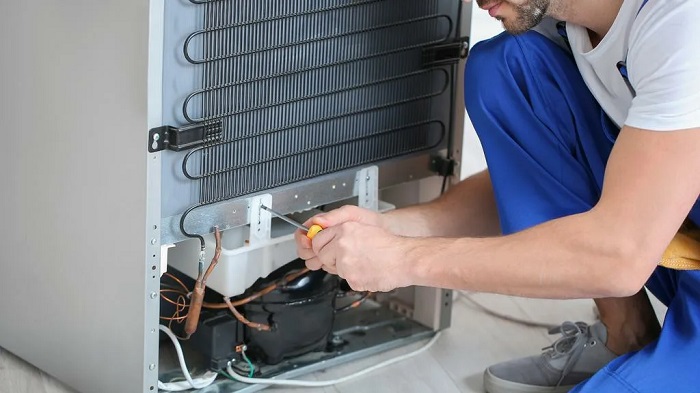
How to detect and fix freon leaks in refrigerators? Let’s find out more.
A Freon leak is one of the most serious yet misunderstood refrigerator problems. When refrigerant escapes from the sealed system, cooling capacity drops sharply, and the compressor begins running nonstop in an attempt to maintain temperature. Homeowners often notice early signs like longer cooling cycles, weak airflow in the freezer, or frost buildup on one section of the evaporator. Diagnosing and repairing these leaks requires both precision tools and knowledge of how the system circulates refrigerant. Below are real examples of how technicians find, fix, and recharge leaking refrigerators.
Case 1: Pinhole Leak in the Aluminum Evaporator
One of the most frequent service calls involved a side-by-side refrigerator that gradually stopped cooling over two weeks. The compressor was running constantly, yet the freezer temperature stayed around +10°C. The technician suspected a refrigerant leak and connected a manifold gauge set. The readings confirmed low pressure — nearly zero on the suction side.
To locate the leak, the technician injected a trace amount of nitrogen mixed with UV dye into the system and used a UV lamp to inspect all joints. The glowing spot appeared along the evaporator coil near the capillary tube — a small pinhole caused by corrosion. Because the evaporator was aluminum, soldering was not an option. The entire coil was replaced with a compatible copper unit, the system evacuated with a vacuum pump, and then recharged with the exact refrigerant type and weight specified on the data label. After the repair, the unit reached stable −18°C in six hours.
Case 2: Leak at the Compressor Connection
In another repair, a refrigerator in a rental property had visible oil stains on the base — a classic sign of a Freon leak. The technician found that one of the solder joints on the compressor discharge line had developed a hairline crack. Using nitrogen pressure testing, bubbles formed at the joint when sprayed with soap solution, confirming the leak.
The old solder was removed, the line cleaned, and the joint re-brazed with silver-bearing alloy. After pressure testing again to ensure no further leakage, the system was vacuumed and recharged. The refrigerator resumed normal cooling, and energy consumption dropped by about 20%, as the compressor no longer had to run continuously.
Case 3: Internal Leak Inside the Cabinet
Some leaks are more difficult to access. In one high-end built-in refrigerator, technicians noticed that every few months the cooling performance dropped again after a recharge. This indicated an internal leak buried in the foam insulation. By injecting nitrogen and monitoring pressure over 24 hours, they confirmed a slow loss. Because direct repair was impossible without destroying the cabinet, a decision was made to isolate the damaged section and install an external evaporator loop.
The modification required running new copper lines through the rear panel and sealing them with epoxy. After evacuation and precise refrigerant charging, the unit functioned as new. Such repairs are complex but often save expensive built-in models from replacement.
Case 4: Capillary Tube Micro-Crack
A refrigerator in a small restaurant lost cooling suddenly after a power fluctuation. The compressor still started, but the suction line stayed warm — an indication of no refrigerant flow. A leak detector picked up trace refrigerant near the filter drier. Inspection revealed a tiny micro-crack on the capillary tube caused by vibration over time. The technician cut out the damaged section, installed a new filter drier, brazed the joint, and pressure-tested the entire system.
After recharging with the correct refrigerant amount, cooling performance returned to normal. The customer was advised to install anti-vibration pads to reduce stress on the thin copper tubing.
Case 5: Slow Leak in the Condenser Coil
Another frequent cause of Freon loss is corrosion in the condenser coil, particularly in coastal or humid environments. In a New York apartment near the waterfront, the technician found corrosion at the lower corner of the steel condenser. The leak was verified using an electronic refrigerant detector that emitted a steady beep near the damaged area. The coil was replaced, and the entire system flushed to remove moisture and debris. After pulling a deep vacuum, the refrigerant was charged to factory specifications. The unit cooled evenly within hours.
Case 6: Overcharging and Its Consequences
Sometimes homeowners or unqualified repairers attempt to “top up” refrigerant without finding the actual leak. In one case, this caused pressure levels to exceed safe limits, damaging the compressor valves. The technician first recovered the excess refrigerant, repaired a small leak on the suction line near the service port, and then refilled the correct charge by weight. The compressor survived, but the incident illustrated how guessing refrigerant levels can make problems worse.
How Technicians Diagnose Freon Leaks
Professional repair always begins with systematic diagnostics:
- Pressure Testing: Using nitrogen to detect drops in system pressure.
- Electronic Leak Detection: Sensitive sensors identify trace refrigerant concentrations.
- UV Dye Method: Fluorescent dye is injected and traced under UV light.
- Soap Bubble Test: Simple but effective for exposed connections.
- Vacuum Holding Test: After evacuation, pressure is monitored for several hours to confirm system tightness.
These combined methods ensure that even the smallest leaks are found before recharging.
Evacuation and Recharge Process
Once the leak is fixed, the technician uses a vacuum pump to remove moisture and air from the system. The vacuum is held for at least 20–30 minutes to confirm no hidden leaks remain. Then refrigerant is charged precisely by weight, using the data plate as a reference. Overcharging or undercharging affects cooling efficiency, so accuracy is essential.
After reassembly, the system is allowed to run for several hours, and pressures, amperage, and temperature differential are measured to confirm correct performance.
Preventive Advice
To prevent future leaks and keep the system efficient:
- Keep condenser coils clean and unobstructed.
- Avoid bending or moving the refrigerator frequently.
- Do not scrape ice aggressively from the freezer walls.
- Schedule maintenance if cooling weakens or the compressor runs continuously.
Freon leaks rarely fix themselves — refrigerant escapes slowly but steadily until cooling stops. With careful detection and proper sealing, technicians restore the system’s integrity, protecting both performance and compressor life. Each repair follows the same rule: find the leak first, then recharge — never the other way around.